Not that there’s any shortage of good blogs, and that’s, in fact, half of the problem. The other half is finding them, or more specifically, finding the ones that scratch my personal itch. I find reading other writers to be a vital tool to inspiring me to write—at least for fiction. A good novel or short story has a tendency to get me writing something. So, I often seek out good fiction. I recently finished reading Pnin by Vladimir Nabokov. I picked that up because it was mentioned in Of Course, You End Up Becoming Yourself, the amazing and sad long-form interview with the late and lamented David Foster Wallace by David Lipsky. I picked that book up because I love David Foster Wallace. I love David Foster Wallace because a friend turned me on to him due to a shared love of Haruki Murakami. I discovered Haruki Murakami by sheer chance, flipping through a book of contemporary Japanese short stories at Central Branch of the Free Library of Philadelphia in my college days.
It’s easy to find a good book, though sometimes I will drag my feet when it comes to reading one. It’s much the same with music. I’m a passionate music fan, but I approach a new band with a certain wariness, happy to sit in the little musical rut I’ve created for myself. Whenever I hear a lot of good buzz around a band or an artist, I get suspicious. I had been told multiple times by multiple people that I would adore the band Sparks, for example. I put off listening to them for ages, but when I did, it didn’t take long for Sparks to quickly become not just a favorite band, but my second favorite band of all time.
How It Was in the Past
Many moons ago, when the Internet was a young, wild frontier that spread out upon a metaphorical prairie stretching to an infinitely distant horizon, it wasn’t hard to keep on top of what was new. Yahoo! began life as an Internet directory, and you could even see what new pages had been added to the Internet each day. By the time I got online around 1997, this was no longer quite the case, but other directories abounded. In fact, my first website was on the now defunct GeoCities, which organized sites by a system of virtual addresses on streets in various themed neighborhoods. When I moved out, the address my site used was taken over by a Dukes of Hazzard fan page. Directories were even useful in the age of blogging. When I set up this site, I had it added to nycbloggers.com, a directory of New York City bloggers, arranged by subway stop. It’s still listed there, under the subway stop by my first college.
Still, as more and more people got online, and more people started posting things, and there were more ways to start websites that were easier and cheaper, it became harder to find cool stuff. I spent a lot of this period on LiveJournal, which made it easy to find people who might be into the same things you were, which isn’t the same thing as finding good writing about those things, but it’s the closest I’ve come. The best part it that a lot of this discovery was mostly organic. I found interesting people who shared my interests and turned me on to new ones.
Anil Dash hit me in his “The Web We Lost” essay, but his lament comes from the technical side of things. I never bothered with Technorati tags in my attempts at blogging—in fact, I always considered tags to be a kludgy and ugly way to organize writing. Still, the early days of “Web 2.0” were all about discovery of content, and now that’s fallen away. The buzzword now is curation, which is fine, but I think there’s a place left for writing, long and short form.
What scratches the itch right now
I organize my RSS feeds in a system similar to Patrick Rhone’s. In my “A-List” folder, I keep Daring Fireball, Marco.org, The Brooks Review, Minimal Mac, and 43 Folders on the off-chance that Merlin will start posting there again. I keep a “B-List” of sites like Metafilter and Boing Boing that post cool stuff, but also have a fair amount of non-signal posts that don’t interest me. This folder also holds other blogs that sometimes post neat stuff. Beyond that, there’s a folder for the friends whose blogs I follow, a folder of miscellaneous blogs that post items of interest or amusement such as bands and humor sites. Then, there’s my big-ass folder of webcomic RSS feeds.
The blogs that I follow in the A-List have certain things in common: a distinct voice, and an interest in technology and Apple products. These are not requirements, however. What is a requirement is a willingness to write long, in-depth articles on things that catch their attention. It doesn’t hurt that most of them are podcasters, too, and I listen to their shows. Sometimes, they link to interesting things, with a short blurb and/or quote, but the thing that draws me to them is not what they link to, but what they write. When I bemoan finding good blogs, I bemoan the difficulty finding blogs that do the long-form writing. I can get links anywhere. That’s why they have [Reddit].
RSS Versus Twitter Versus Whatever Else
A while back, I remember reading of people bemoaning RSS readers, and giving up subscribing to blogs in lieu of having people cultivate links for them via Twitter, or whatever. There’s been a recent trend in e-mail newsletters, like Dave Pell’s NextDraft, which I subscribe to. Apps like Flipboard can scrape out the links from my Twitter, Facebook and Tumblr feeds and put them in a shiny, magazine-like UI for me.
Maybe I’m just old school, but I like RSS readers. I don’t see it as an obligation to get to the bottom of the pile, though I do anyway. I launch my reader of choice, Reeder, when I want to read something. When I’m done, I close it. It only fetches things when I run it, and I’ve disabled the litle red notification dots on my iPad and iPhone so that I don’t have anything nudging me to read the things I neglected. Thanks to Instapaper, if something piques my interest, I can save it for later, and read it on the subway. I don’t care how often they update. I want good, interesting writing about the things I care about, or a writer who is capable of making me care about new things.
And that’s hard to find. But I know they’re out there. When there’s one, or five, there’s even more.
Recently, one of my favorite podcasts, Back to Work began a short series of episodes, devoted to Getting Things Done[1], the productivity system endorsed and praised by countless nerds, bloggers, and nerd bloggers. Since the start of the series, I’ve gone back and started re-reading the book, reacquainting myself with GTD and its tenets. If you’ve never read it, and you’re overwhelmed by the stuff on your plate, then by golly, go get a copy. Re-reading it has been rewarding, and lord knows that I’ve had some… issues… with getting things done [2] in my past. Merlin’s discussions and returning to the canonical text have been helping me get myself in order. What has not been helping are the panoply of other self-help books, blogs, and podcasts I’ve been reading and listening to.
I could provide a list of what I’ve been reading, or at least skimming, but why bother? The problem isn’t with the people who post this stuff. They’re only sharing what they’ve done to make their lives better, and who can blame them? It reminds me of a recent experience on the subway where a woman began reciting at us a clearly rehearsed and prepared litany on embracing the tenets of her religion. The key difference between her and the writers and podcasters I’m burning myself out on is that they’re not coming to me preaching The Way of David Allen—I’m coming to them. Nothing’s stopping me from unsubscribing from their feeds. Nothing’s stopping me from not buying their books.
Merlin Mann once wrote, “Joining a Facebook group about creative productivity is like buying a chair about jogging.”I’ve quoted it before, but it bears repeating, especially in this context. I can read all about ways to use Evernote, how I can be productive with only the pre-installed applications on my iPhone, or how setting my desktop to a shade of blue has been found to increase productivity by x percentage, but these things are not making me productive. They’re interesting, but they’re not helping. Reading about whether I should add a new application to my workflow, whether I should use Things or OmniFocus, or whether I should just write down the three things that I actually need to get done today on an index card—these can help on a theoretical level, but they’re not helping. At least, they’re not helping me.
What is going to help me is to spend less time worrying about implementing a system. What is going to help me is to spend less time figuring out what application to jump ship to. What is going to help me is to spend less time setting up fiddly little AppleScripts, templates, and other hacks. What is going to help me is not spending money on another pop-psychology book about how I can be more creative, productive, content, brave, happy, and the Best Me That I Can Be, because not a single god-damned one of these things will actually change anything. The best self-help these things have inspired me to do is to declare my independence from self-help. I’ll have more hours in the day to make things if I’m spending less time reading blog posts, listening to podcasts, and keeping up with the latest book about how I can change my habits. It’s a question of mathematics. It’s also a question of priorities.
Let me step back a bit. One of the reasons I listen to Back to Work is that I sincerely enjoy it. Even when I don’t get a whole lot of practical use from an episode [3], I still enjoy hearing Dan and Merlin talk. I still read, and will continue to read some of Patrick Rhone’s stuff, and listen to Enough because Patrick provides enough value and edification that the time spent is worth it. It’s those other blogs and other podcasts that insist on large chunks of my attention that I’m unsubscribing from. I’m not getting enough back from my mental investment to justify it.
More importantly, I’m putting up roadblocks to adding more of this self-help stuff to my life. Maybe if someone I know and respect links to a blog post that touches on some of the things I’m avoiding, I’ll add it to the ol’ Instapaper queue. That seems fair to me. What I won’t do is add that blog to my RSS reader, follow the author on Twitter or App.net, or subscribe to their e-mail newsletter—even if their ideas are intriguing to me. Life is too short. My time is too short. I’ve had enough self-help.
I’ve also had enough of writing about self-help. I no longer feel like publicly fluffing myself about being a productive person any more. I’m getting less out of writing about it than I am reading it. Every day, countless people get their shit done. For some it’s easy, and for some its hard. Either way, the vast majority of them don’t go patting themselves on the back over what they’ve done, let alone doing it for an ostensible audience on the Internet. They just get on with the business of living their lives. Count me out of the circle-jerk. I’m ready to put my hands to use doing something more important.
I recently read an interesting article on dopamine, and our addiction to seeking information. As the proud owner of an iPhone and an iPad, and as someone with a Twitter account, a Facebook account, an App.net account, 78 RSS feeds in Google Reader, and three main e-mail accounts, I have to admit that it hit home. I’ve fallen down the Wikipedia Rabbithole. I’ve been on Reddit until stupid o’clock in the morning. I’ve gone to the bathroom, and checked all my major social networks in the space of a single micturition. I do these things daily. Multiple times.
I am the rat pressing the button, not knowing if this next press will produce the food/electrical shock to the pleasure center of my brain. Eventually, it will get to the point where I will go insane, or break the cycle. Clearly the latter is the better option.
Despite being the sort of person to quit my job, pack up my life, and move to a new city without a job or much of a backup plan, I’m not the sort for extreme solutions to problems. I’d rather adjust my relationship to the gadgets that tug on my brain than throw them away completely. One thing I’ve done is switch to using Twitter and App.net exclusively on my iPhone and iPad. [1] I’ve also started using my time on the subway as time to “be disconnected” either reading a book[2] or just not doing anything at all.
Even after only a couple of days, the results are positive. It may be too early to tell, but I’ve found myself with ideas for writing, fiction and otherwise. Even better, I’m getting off the subway and simply feeling better and less stressed. With less inputs, and less chance to seek inputs, my brain has to let go of the dopamine and wind itself down. An hour a day on the train will probably never be enough. This is the sort of thing where meditation, or other practices may help. Hell, this is one of those things where turning off the Wi-Fi may help.
I freely admit this was a side effect of performance issues while running Tweetbot and Wedge on my decrepit MacBook. ↩
Typically, I do my subway reading on my iPhone, but since the subway in New York City has no cellular service except in a few random stations, I can’t go checking my social networks. ↩
I’ve always been bad about putting things away—especially laundry. During my bachelor days, it was common for me to haul my laundry back into my apartment, up three flights of stairs, hang up my shirts and pants, and leave a clean pile of unmatched socks, t-shirts, undershirts, and underpants at the foot of the bed. However, I avoided the bachelor problem of not knowing which clothes were clean and which were dirty. Dirty clothes always ended up in the vicinity of the hamper, which I kept in my bedroom closet. Rarely, if ever, did these two piles collide. Obviously, this wouldn’t cut it forever— especially now that I’m sharing my living space again. There’s an old axiom: “A place for everything, and everything in its place.” Rarely is that place “the floor,” unless we’re talking about area rugs.
My current living arrangement doesn’t afford me a lot of space for my stuff. I already reduced the amount of stuff I have a fair amount before I moved up here—or rather, the amount of stuff I took up here is a reduced amount of what I had. What I didn’t sell or donate is in storage back in Philadelphia. I have two plastic containers that I keep my clothes in, save for the stuff that gets to hang in the closet. Two plastic containers aren’t the most ideal place to store clothes. So, for a month or so, clean clothes ended up neatly folded and stacked on top of one of the containers.
These neat stacks lasted about a day. When I got dressed in the mornings, the stacks fell apart. Neatly folded clothes became crumpled balls, and so it was until I’d worn a week’s worth, and laundry day came back around. Sometimes my button-down shirts got hung on hangers off a shelf. Sometimes they got folded and stacked on the container. Wherever they were, it was all a cluttered mess. Once they were put away, I felt a sense of great relief. Something I hope to keep feeling.
The laundry is just one aspect of learning to find a place for things, and put them there. As I mentioned last week, I have trouble putting things into my system, in much the same way as I have trouble putting my clothes away. And books. And anything else. The point of having a system is to know not only that something is in it, but that you have a place to put things. Events go on a calendar, tasks and projects go into a task manager, my clothes go into the closet, or the plastic containers. It’s not hard, at least in theory.
I used to wake up many mornings, get ready for work, and be unable to find my keys. Why? Because I didn’t have a specific place for them. Sometimes, they ended up on my dining table. Sometimes, they ended up on the desk, or occasionally on the end table, or the dresser, or the kitchen counter. In the haze of the morning, it was impossible to remember where I put them, so unless the keys were in the first place I thought to look, I’d panic. Now, my keys go right next to me, on top of the short bookshelf in the bedroom. Recently, we put an organizer on top of the bookshelf, which holds all sorts of stuff. It holds my wallet, my pocket notebook, pen, pocket knife, and wristwatch. Now, there’s no need to fumble around in the morning trying to remember where any of these things are, if they’re buried under papers, got knocked off and into the trash can, or anything else.
For a chronically disorganized guy like me, this is a revelation. It’s one less thing to worry about. Every disorganized person can tell you they know where everything is in their mysterious piles of stuff. I could. Until I couldn’t. One minute you’re confident in your lack of a system, and the next moment, you’re desperately looking for your W–2 form, cursing, and messing up all your piles. If there were a letters column for people who experienced this phenomenon, they would all start out like something from Penthouse Forum: “Dear Disorganized Forum, I never thought this would happen to me…” For the skeptics, I suggest you try it, just as an experiment. For the true believers, keep it up, but spread the gospel gently. Us disorganized are slow to change and easily backslide. The harder you push, the more we will resist, until that moment of clarity occurs.
When I go to work and sit down, I know what I need to do, when it needs to be done, and how to do it. I don’t need a task management system, GTD or otherwise, to make my job go. It’s everything else I need a system for.
Without looking, here’s a brief list of the “projects” on my plate: I have a redesign of Sanspoint I’ve been working on, a site I’m creating for someone else, a podcast to record, edit, and post, a novel to write, two short stories to revise, an album review to write, posts for Sanspoint to write, music to listen to (for myself, and Crush On Radio), and more. Most—though I freely admit, not all—of this stuff has ended up in my task manager. When it’s in the system, it’s everywhere: my laptop, my iPhone, and my iPad.
And it stays there. If the stuff in my task manager were organic material, it would officially qualify as either a biohazard, or a compost heap.
This is untenable.
I’m not the only person with this problem, and in the last few months I’ve seen several articles on the web on how to fix it, or hack around it. Off the top of my head, there’s:
And, lord, I am not going to reiterate my struggles with finding the right GTD application. It makes no difference what app I use if the work doesn’t get done.
There’s two disconnection points: getting stuff into the system to be dealt with, and then dealing with that stuff. The first is easier to deal with. In fact, after I wrote the first few paragraphs of this essay, I loaded up the Trigger List and went through, and had a short brain-dump, gathering various open loops and putting them into Things.app. Here’s a sample, my own internal syntax included:
Comms
** Reply to REDACTED review * REDACTED, RE: REDACTED Relaunch
* Call Hover.com, re: DNS issues with wantabreathmint.com
Writing * The Residents Project (ongoing)
* Sanspoint (ongoing) * Non-Rez Pro Kittysneezes (ongoing)
* Crush On Radio stuff (stalled)
Evaluating the writing side, I went back to a great essay by Antony Johnson called “Getting Things Written”. It shows off a lot of the shortcomings in GTD’s workflow and the bothersomely open-ended nature of writing tasks. Unfortunately, I don’t find Antony’s solution to be workable for me. Job sheets only work when there’s a physical thing. There’s very little physicality to the writing I do, which is almost exclusively for the Internet. [1] He makes a point though: “the definitive nature of NAs being ‘done’ or ‘not done’ simply doesn’t suit work where something might only be half-done, but can’t be finished by merely putting more hours in.”
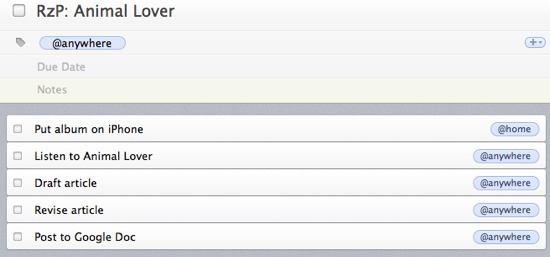
By way of example, here’s what a typical writing project looks like for me in Things. [2]
First, a few words of explanation: the “@anywhere” context means that I can do this part of the task, more or less, anywhere I am. I’m on the subway? The album’s on my iPhone, so I can give it a listen. I’m laying on the sofa with my iPad? I can type up a first draft, or revise the one I have. It’s lunchtime at work? I can export the manuscript, copy and paste it into the shared Google Doc.
Going from this task list to actually a finished thing is the problem. These tasks exist in an odd state of being as defined as possible, and still nebulous and open-ended. I try to keep these articles around 500–600 words, but that’s neither a minimum or a maximum, and the time it takes me to write those words can vary. There are days when even the best of us struggle to put down one good line of text on paper.
Obviously, the two failure points in this system, the disconnects on stuff getting in and stuff getting out, are really only one failure point: me.
I talk a big game about GTD in this essay, but I’m actually quite terrible at GTD. For example: I don’t do reviews. For a while, I had a Morning Review project that popped up every morning, but it wasn’t exactly great: check my tickler file [3], check my e-mail and add stuff to Things, check the projects in Things, and add tasks to my Today list. I have no Weekly Review. I have no Nightly Review. As it stands right now, I don’t even have a physical inbox, but I also don’t have much physical content to address.
The point of GTD reviews is to shake out the last parts of what is rattling in my head and formulate a plan of action for the week ahead. When I know what I have to do, I can do it. Like at my job. Every morning, I come in, sit down, and know exactly what has to be done, and how to do it. I’m also finding ways to improve my workflow there. There’s also the context shift that comes with going to work. When I’m there, I’m there to work, and they’re paying me for it. [4]
Making that context shift at home is going to be the tricky part—I’m not about to impugn upon my employers goodwill and start writing the novel in my down time at the office. This is going to involve more hard landscape stuff, working with timers and scheduled work periods. Something not dissimilar from when I was looking for work, and firewalling off time to search for jobs, only getting to dick around on the Internet when my work time was up. I accomplished that with a Safari extension. Perhaps I should look back into that.
Knowing and doing are the foundation of actually getting things done. (Lowercase intentional.) They have to work together. One alone does not productivity make. I can know I have a review I need to write, and not do it. I can do a lot of writing, but if I don’t know what to write about, it’s not likely to go anywhere. I can also fix the metadata on my MP3 collection, but that’s still going to leave me in the same spot. I need both. Now I know.
The novel isn’t at a state where I should be worrying about a physical product yet, and I’m not even sure I’m going to go for traditional publishing. These are concerns better suited for a finished product. ↩
In this case, it’s my part of an article for The Residents Project, an ongoing series of articles at Kittysneezes reviewing every album by The Residents. They have a lot of albums. ↩
Yes, I use an actual, physical tickler file, with all forty-three folders. I experimented for a while with a ten-folder setup: one for each day of the week, one for the next week, and one for everything after that, but it was more of a hassle to do it that way. ↩
The day after Hurricane Sandy passed through New York, and the subways weren’t running, I worked from home. One day of it was enough to swear me off of remote work forever. There’s too many distractions, and a I have a suboptimal home office environment. ↩