It seems to me, now more than ever, that our interactions with others often turns into the trading of barbs. Any opinion expressed runs the risk of being reacted to with snark. [1] I know I’m not the only person who sees this. My friend Andrew Marvin touched on this a few months ago.
We allow other people to affect ourselves like this all the time. It’s a perfectly natural, human thing. Of course we should care about what our loved ones think. But when it comes to minutia—like what someone’s drinking—I can’t see any worthwhile reason to care.
Ask yourself, “How does this person’s decision affect me?”
If the answer is that it doesn’t, that’s great. Let go, and become a little bit more free.
If the answer is something negative, ask yourself why. Is it a good reason, or is it kind of silly?
These are important things to ask, but another important thing to ask is why we are compelled to even remark? What is the root of the snark problem? Why is so much of my dialogue, and other people’s, so concerned with negativity? What purpose does snark serve, and what drives us to use it when there are far more constructive means of communication at our disposal?
For me, the problem took focus as we wrapped up Episode 5 of Crush On Radio. What I intended to be a sedate discussion on special editions of albums and their bonus tracks became a very opinionated, and often very nasty rant on my part. After we wrapped up, I immediately laid down a rule for the show that we can’t have another episode that is all griping and snark. It’s not constructive and contrary to the spirit of the show, which is about sharing music and stories about music with people.
What makes avoiding being snarky so difficult is that it’s omnipresent in society, and on the Internet especially. One can’t state an opinion in a public forum without having at least one person insult not only your opinion, but you. For an example, look at the comments on almost any story on a newspaper website. No matter what the topic, politics, culture, technology, food, you’re bound to say something that will set someone else off. After enough of this, it becomes natural to take the defensive position and pepper your statement of public opinion with harsh invective from the start.
The worst part of all this snark is that it’s not constructive. Even if there’s something of value buried beneath the vitriol, it doesn’t get through. When someone is snarky, even if the point they make is valid, it automatically puts the recipient on the defensive. They don’t take the time to ponder the valid point, they only defend themselves harder. Facts already have a tendency to make people who disagree with them strengthen their disbelief. Delivering a valid statement in a way that is going to cause offense certainly isn’t going to help.
It’s a leap to say that the problem of snark in offline life, whether we speak it aloud or not, is a direct result of Internet-based snark. Despite this, immersing oneself in this well of negativity, anger and trolling has to have some effect on how we conduct ourselves when we’re away from it. Was I so willing to be an aggressively sarcastic, snarky jerk—even if it’s in my head—before I got involved in online discourse? Who can tell? Either way, as I get older and, presumably, wiser, I see this becoming a problem for myself and others. Since I can’t change their behavior, I’ll have to start with myself.
Next week, I’ll be proposing a Solution
For those new to the term, “snark” is a neologism, a shortened form of “snide remark”. ↩
There’s a certain fetishization of creativity, now more than ever. Molly Flatt in her essay, “The Cult of Creativity†explains how:
The amorphous concept of ‘creativity’ has become the unquestioned MacGuffin of our times, and anyone who doesn’t demonstrate it – or at least a willingness to cultivate it – is in danger of being labeled a conservative desk-monkey unfit for the creative rigours of our fecund social media world.
She also mentions the “over 335 million results†on Google for “become more creative,†and Amazon listing “11,468 books with the word ‘creativity’ in the title.†I know I’ve read more than a few of those web sites and books, and only a precious few have actually helped. Once again, I have to quote Merlin Mann: “Joining a Facebook group about creative productivity is like buying a chair about jogging.†No matter who they are, anyone—myself included—who says they can make you more creative is talking out of their rear end. Creativity isn’t the fluffy, magical gift-of-the-muse. It can feel that way, because when inspiration—another loaded word—hits, it often comes out of what seems like nowhere. Science doesn’t back that up. John Cleese provides a great explanation of how creativity really works, and grounded advice on how to be more creative. It’s took long to summarize here, but the quote to take away from it is this: “Creativity is not a talent. It is a way of operating.â€
Here’s the thing: humans are innately wired to create. It’s why there are 17,000 year old cave paintings in Lasceaux, and why make lolcats and rage comics today. The creative instinct is innate and it is essential for human survival. Without it, we never would have figured out to make spears to hunt animals with—or each other, for that matter. Some of us are naturally better suited to certain creative endeavors than others, anyone can still be creative. The inherent difficulty doesn’t justify the fervent worship of the idea of creativity, or the sheer lunacy of people who claim “Oh, I never could do that†when they see creative work. It’s not that you can’t, it’s just that you didn’t. The flip side of this is the line: “Oh, anyone could do that.†You see that one tossed at modern art a lot. Maybe anyone could do what Mark Rothko did, but Mark Rothko did it and you did not. There’s valid reasons to dislike Mark Rothko and related abstract expressionist works, but claiming “Oh, my toddler could paint that†is not one of them.
The worst part is that a lot of other creative types get into the game of making creativity into something mystical. Everything I read that connects creativity with some spiritual mumbo-jumbo makes me want to retch on a very specific level. The people who peddle that crap are often either trying to peddle more “you can be creative too†junk for people to buy rather than actually be creative, or artists with their head too far up their own ass to provide practical, grounded advice. I will make an exception for Stephen Pressfield’s The War of Art, which has spiritual mumbo-jumbo, but tempers it by hammering the point that the spiritual part doesn’t happen unless you actually sit down and do the work. [1] When it comes to the idea of the “muse,†Stephen King got it right in On Writing.
There is a muse, but he’s not going to come fluttering down into your writing room and scatter creative fairy-dust all over your typewriter or computer… He’s a basement kind of guy. You have to descend to his level… You have to do all the grunt labor, in other words, while the muse sits and smokes cigars and admires his bowling trophies and pretends to ignore you. Do you think it’s fair? I think it’s fair.
It’s fair, but it’s far from pleasant. Writers and artists often live in an abusive relationship with their art. No wonder so many of the best of our ranks fall to drug and alcohol abuse, mental illness, or suicide. Never trust a so-called artist or writer who brags about how easy it is to do their work, because they’re probably terrible. It’s not easy to do creative work, but if you do it long enough, it does get easi_er_. Even someone at the top of their game has those days when they look at the page—blank or otherwise—and says “I can’t do this today.†They go through the litany of abusive self-talk to themselves. What separates the artists from the non-artists is that when they miserable, angry, abusive self-talk is over, and they’ve convinced themselves that they suck, are the worst possible person in the world, and that they should burn everything they ever made, sell their worldly possessions, and live like a hermit in the mountains, licking lichens off rocks to survive, they sit down and start to work anyway.
Why?
You might as well ask the sun why it rises, or ask the sparrow why it returns to Capistrano. Ask the salmon why it swims upstream to the place of its birth to spawn. It must be done. It’s an innate, deep, internal desire that is as essential to us as breathing. It takes priority over everything else, because to us, it is everything. Like sharks, if we stop moving, if we stop doing the work, we die. No matter what form of art we do, the only thing that is worse than doing the work is not doing the work. No matter how miserable the process is, it’s preferable to the alternative of not doing it. There is, of course, the option of changing what you do, but it’s still doing the work. It’s still being creative.
The only practical advice worth giving to anyone who “aspires†to be creative is this: just sit down, take a block of time, and do the thing you want to do. If you have to buy a book, buy one that talks about the actual nuts and bolts of the thing you’re trying to do: a textbook on iOS programming, or Piano for Completely Inept People. Whatever it is you want to do, the only thing that will make anything happen, creatively speaking, is sitting down and doing it, and the motivation for that has to come from within. It’s there, in all of us. Make the time, play around, make mistakes, and beat your fists against the wall in frustration. No book will do that for you.
The Saturday morning before my big move, I woke up to find the external drive I keep all my media on: music, movies, books, TV shows—my entire iTunes library—had died. My first thought that I really didn’t want to spend the money t replace it. Recovery wasn’t a concern. Everything had been backed up to my Time Capsule. The worst that could happen would be losing the last couple albums I imported into iTunes, but that wasn’t the case. All I had to do was replace the hardware. I ordered a 1TB USB drive from my local Apple Store. After recording that week’s Crush On Radio, I picked up the drive, ran home, and started restoring.
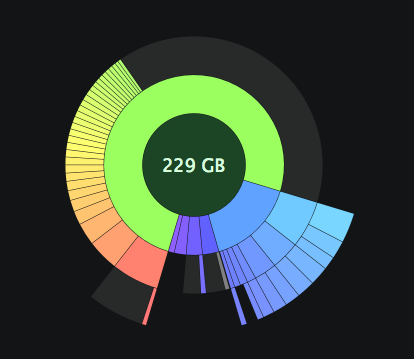
The process took the entire weekend, largely due to the sheer size of my library, and a few false starts. The experience has forced me to think about why I have such a massive media collection. What compels me to hold on to all of this stuff? What compels me to get more? Is it some sort of psychological disorder? The most insidious thing about hoarding files is that it’s largely consequence free. If you’re a digital hoarder, you don’t have to worry about the same problems that come with real objects. No matter how many MP3s or ePubs I have, they’re not going to collapse and crush me to death. [1] Hoarding MP3s doesn’t make for the kind of compelling visuals that suit an episode of Hoarders.
Pretty, but it doesn’t make for compelling television.
At least when it comes to music, I have some justification. I’m an avid music fan, music writer, host a music-related podcast, and I am a completionist. When I like a band, I want everything by that band, or as much is feasible. In the world of collecting physical goods, one is limited by budget and availability. Some stuff is outright rare, and if you want it, you’re probably going to have to pay through the nose. The Internet puts almost anything we could possibly want at our fingertips. With a fast enough connection, the complete discographies of artists are at our disposal in minutes. All you sacrifice is the actual, physical product. Since I’m the sort of person who actually listens to music, albeit a lot of the same music over and over, this is fine with me.
On the second episode of Crush On Radio, we briefly discussed our digital music collections and how we managed them. Before Crush On Radio even started, I had tried to do some pruning of my collection, but now every week at least one album’s worth of material gets added to the library. I’ve also been lax at purging the stuff I don’t like. I rarely get a chance to get back to the albums I downloaded to check out and never have. Last year, I got the latest album by Cut Copy, Zonoscope, but only finally listened to it a couple months ago. It’s an amazing synthpop album, and I love it. Unfortunately, I haven’t played it since, but I probably will, in time. Perhaps it’ll be a pick on an upcoming Crush On Radio
However, I’ve never been a huge movie person, with the exception of Wes Anderson movies. This makes the large movie folder on my media drive all the more absurd. Why then do I have so many movies I’ve watched once—or never—taking up space? Laziness, no doubt. About the only evergreens in my movie collection are concert films. [2] It’s much the same with the piles of unread e-books and unwatched TV shows. As much as I’d like to catch up with Doctor Who, I’m only at the start of Series 3, and only getting further behind. The only TV series I like an am up to date on is Boardwalk Empire, and that’s because I got in at the start. Even the shows and movies I have watched sit around, and I don’t know when, or if, I’ll get around to watching them again. More to the point, why bother keeping them when I can stream them on demand through means legal and otherwise.
What I have to do is re-evaluate when, where, and how I consume media—especially music, and be more judicious in what I acquire and when. Also, I have to be more judicious in what I purge. If I’m unlikely to go back to something, why keep it around? No matter how big my media drive is in capacity or small in package, its contents take up non-physical space in my psyche. I see the cover art as I scroll through iTunes. I am nagged by the empty space under “Play Count†when I click them, and try to decide if it’s truly what I want to listen to, or not. What gems are sitting there that I’ve missed? More importantly, perhaps, what junk is sitting in there that is not going to be worth my time at all? As I figure all this out, I expect to revisit this topic. If you have any suggestions, reach out.
Monday night, I undertook a long, arduous journey from my new home in Jamaica, Queens. I took the subway far down Queens Boulevard to the distant neighborhood of Astoria. [1] There, I made my way up to Broadway, and over to the Astoria branch of the Queens Public Library. There, in a basement meeting room split incompletely by a divider with a stuck door, I sat with about a dozen writers wielding various implements. On the other side of the divider, a woman was teaching a class on American culture for new immigrants. Every few minutes, the room shook and thundered as the M and R trains passed below us. Under these conditions, my fellow writers and I sat, and did nothing more than bang out words for a full hour.
It was exhilarating and productive. I’d opted to use the hour to bang away at my novel, a project that has been going on in fits and starts for the better part of five years without so much as producing a complete first draft. As the room shook from another subway train, I remembered an idea I had for a scene where a character is attacked on the subway. So I wrote it—nearly 1600 words of it. Once it was on the page, I felt a great weight had been lifted from my soul. All I had to do was pack up my laptop, leave the apartment, ride the subway, go into a room with a bunch of other writers and no Wi-Fi, and then make the clackity noise for an hour. [2]
After a day of personal highs and lows, it felt absolutely wonderful to pick up this project, blow off the dust, and get back to work. A change in environment can accomplish wonders. In a room with a dozen people, half a dozen laptops, an iPad, an couple notebooks, and some scraps of paper, where all there was to do was write, I wrote. No nonsense, no bullshit, and no handwringing. There’s a reason this group is called “Shut Up and Write! NYC”. We introduced ourselves, sat down, shut up, and wrote.
Actually, we sat down first. Either way…
I picked up exactly where I had left off the last time. It felt like walking into your home after a long vacation. Everything was exactly as I had left it. The Scrivener file I keep my novel in was in the exact same spot, with the exact scene I had been working on last. As projects go, writing a novel is evergreen. As long as the file is saved and backed up properly, it’s not going to go away unless I drag the Scrivener file to the trash. My dog is not going to eat my first draft. [3] What “Shut Up and Write! NYC” did was force me to make the time for this project.
Other project haven’t been so neglected. I’ve written ten articles of various lengths for Sanspoint in the last nine weeks. I’ve been working on The Residents Project for Kittysneezes and, not only have I not missed a week since we started, I’m two albums ahead. We missed one episode of Crush on Radio since May, and that was only because two-thirds of us were simply unable to do it. But the novel… the novel hadn’t been touched in months, until Monday evening. Now it’s been touched, and it feels great.
1600 words is a great number of words to have produced. If you’re one of those lunatics who does NaNoWriMo, the required pace is 1667 words per day, which I could have done that night if I had another five or ten minutes, or just typed a little faster. It’s a respectable pace, and if I can do that amount in a mere hour, I can reach my goal of 50,000 words with eight days of one hour writing sessions. That sounds stupefyingly easy to do, assuming I make the time. I’ll be back at the Astoria Library next week for the next session, but that shouldn’t be the only time I do the work on this project.
Time commitments are difficult to make. My original plan on Monday was to try a fixed schedule of work. I added hour-long blocks to my calendar with fifteen minute breaks between: morning writing, job searching, my freelance copyediting, lunch, more job searching, more writing. On Friday, however, I received an offer to interview for a job on Monday, throwing those plans out the window. There’s nothing stopping me from putting them back on another day, however. Putting these things on my calendar is all about making the commitment to do these things in my copious free time, and get them done. “Shut Up and Write! NYC” helped make me make a contract with myself. Adding these work periods to my calendar and treating them the same way helps to avoid blue food in my refrigerator of my life.
If there’s a lesson to take away from the most productive hour of writing I’ve had on this novel since the night I started it, five years ago, it’s that making the commitment and honoring it is the only way to get anything done—and it helps when you’re surrounded by others doing the same thing. Thinking about it, this may be why many of the other creative projects I’ve been working on are going so well. They’re group efforts, and when you’re with others and accountable to others, you get fewer excuses. Public commitments are much harder to break than private ones, whether its updating a blog every week, doing 10,000 push-ups in a month, or just writing for an hour in a public space.
Actually, it’s only about half an hour by subway, but it does involve switching trains, which is arduous enough considering how good the MTA is at scheduling. ↩
Well, considering the keyboard on my MacBook, it was less the clackity noise and more the tappity noise, but the point still stands. ↩
I coasted my way through elementary school. I coasted my way through middle school. I coasted my way through high school. When I went to college, the coasting stopped for a while, but in time, I found I was able to coast there as well. You coast by expending as little effort as possible to meet the expectations set before you. I could do homework assignments and write papers the night before—in college, sometimes an hour or two before—and earn perfectly acceptable grades. I pulled down A and B grades, on papers done in panicked states the night before. I churned out papers about books I hadn’t finished, or even read past the first few chapters. I knew what my teachers wanted, I knew how to do it, and I knew how to spell. I knew how to, if necessary, pad a paper out without making it look like it was padded.
Teachers either loved me, or hated me. In my high school American History class, my teacher would write detailed outline notes on the blackboard for us to copy down. I never did. He noticed this, but also noticed that I got and understood the material just by reading the notes and the textbooks, and let me slide. He loved me. I took another class with him. In high school geometry, the teacher taught the class with a hands-on method using tracing paper, compasses, and protractors. We figured stuff out ourselves, and I hated it. I picked up what needed to be picked up inside of the first five minutes. I slept through most classes, yet aced every test. She hated me. I earned no credits in geometry that year. [1]
This did not set me off on a good footing for my adult life.
I don’t know the root cause of my coasting, but I suspect it’s tied to my ADHD. [2] Sitting down and doing the work is, without a doubt, hard. For me, it couldn’t possibly be harder. There’s always some squirrel fighting for my attention. Even as I write this paragraph, I stopped to check a link in the show notes of the podcast I’m listening to while I work. Before that, I tried to do a Google search to find out if there’s syntax in Markdown to do an <abbr> tag. I’ve checked Twitter, and Facebook. When I was younger, I kept a TV on in my bedroom over my computer so I had something to distract the distractible part of my brain when I actually did my homework. It didn’t work. TV, computer games, and my own navel were all much more compelling.
Without something caffeinated in the morning, I often can’t get down to work at all.
The pieces are falling into place.
Here’s the thing: I’m pushing thirty. I’ve graduated college, had a few years in the work force, and I’m only figuring out these things now? I suspect a large part of this came from the lack of consequences in my coasting. That’s not to say I didn’t experience any consequences at times. The first time I ever got an F was a fourth grade test on poetry and rhyme schemes. I failed my Seventh Grade English class three semesters running, ruining my grade average in a year that determined what high school would attend. I failed out of my first college in three semesters. I spent a year out of work, slowly going insane.
Marcel Proust wrote:
We do not receive wisdom, we must discover it for ourselves, after a journey through the wilderness which no one else can make for us, which no one can spare us, for our wisdom is the point of view from which we come at last to regard the world. The lives that you admire, the attitudes that seem noble to you, have not been shaped by a paterfamilias or a schoolmaster, they have sprung from very different beginnings, having been influenced by evil or commonplace that prevailed round them. They represent a struggle and a victory.
The question is what lesson did I take away from those failures? That depends on which one we’re talking about. My earliest failures taught me the limits of how little effort I could get away with, and that minimum only increases over time. Once you’re away from the structured environment of the modern American education system, the amount of effort you need to exert goes up exponentially. Maybe that’s why it’s taken so long for me to see the problem, and so long for me to work on solving it. Touch the stove enough times, and you’ll either realize it’s hot and stop, or you’ll get burned.
I’ve been burned.
It’s my own damn fault.
And owning up to that is, of course, the first step.
But, I’m learning how to deal with all of this. I’m learning to actually do the work, even with my a-neurotypical brain chemistry. A lot of the methods are hacky kludges, in lieu of something that can properly modify the chemical soup I live in. One of the biggest things is, of course, writing stuff down. Developing a trusted system to get things that have to be done out of my head, organized, and in a place that I can process them so I can know what has to be done and when has gone a long way to improving my work ethic.
Not all of these are based on the GTD methodology, though Things does play a major role. There’s also Lift for keeping track of all the things I have to do daily that I don’t already. When I’m doing stuff that’s tedious, I use timers. Lately, I’ve started using Pomodorable, which integrates with the Today list in Things. I choose the task I want to do, and a 25 minute timer starts ticking away. It’s an app that’s still new, and a bit buggy, but I think it shows great promise. It’s already becoming a vital part of my workflow.
I owe a large part of this essay to the most recent episode of Back to Work, and the wonderful conversation I had in the chat room during the show with people just as messed up as I am. This essay is just my own personal experiences, and my own personal set of tools. I have the help of technology—which is a double-edged sword I’m still learning to wield—and a loving partner to catch me. There’s still a ways to go.
Even for those of you who are a bit more neurotypical, and can get things done, and don’t need medication or therapy or “lifehacks” may find something of value in the idea of cultivating ways to patch up your own weaknesses. We all have our problems, and we all have our neuroses and things that get in the way of living our lives and making stuff. Sometimes, we need a yellow foam ball to relieve our anxiety.
As long as the work gets done.
And as long as the work that gets done is done to the best of our ability, without shortcuts, last-minute scrambles, or simply coasting on the minimal amount of effort. [3]
For me, that’s been the hardest lesson to learn.
A brief explanation about the way my high school worked. Students did not get grades, but earned credits. Ten credits completed a course. One could, if they applied themselves, graduate early by earning credit faster. I almost graduated late because of geometry. ↩
n.b. This is self-diagnosed ADHD. I am not a medical professional, but I was diagnosed as possibly ADHD as a child. My parents opted to not medicate me. Once I am insured, I plan to get properly diagnosed, and we’ll take it from there. In the meantime, I have to work with the data I have. ↩
If medication makes the work happen, I don’t consider that a shortcut, only another tool. I’m not preaching the anti-psychiatric medication gospel here. ↩