I won’t take back some of the awful things about the Health app in iOS. It’s a clunky, poorly designed app that either needs a UI overhaul, or be hidden so that other apps can use its storage and synchronization APIs without taunting users into opening it. Still, with Apple Watch and apps that take full advantage of HealthKit, fitness tracking on iOS has improved a lot in the last year. The only place it falls down is that it’s easy to get data into Health, but very hard to get it out for whatever you want to accomplish with it.
I’d love a way to get a quick glance at my personal health data, especially historically. Health app sucks for this, and the individual apps that feed data into HealthKit are all fractured. MyFitnessPal is a great food tracker, and a miserable experience for exercise tracking. The Apple Activity app is great, but doesn’t sync with anything but Health. My preferred fitness dashboard, Fitport is good for a picture of your day so far, but does nothing for historical data. Piping all my hot, fresh fitness data into another service, like, say, Jawbone, is a world of hurt. I need another solution.
Many moons ago, I used Brett Terpstra’s Slogger to pipe my FitBit data into the awesome Day One journaling app. When I gave up on / lost my second FitBit, I gave up on saving that data. Slogger is cool, but it’s also a pain in the ass to set up, and won’t get data out of Health, anyway. That lives on my iPhone, not anywhere Slogger can get at it. So, my fitness data languished.
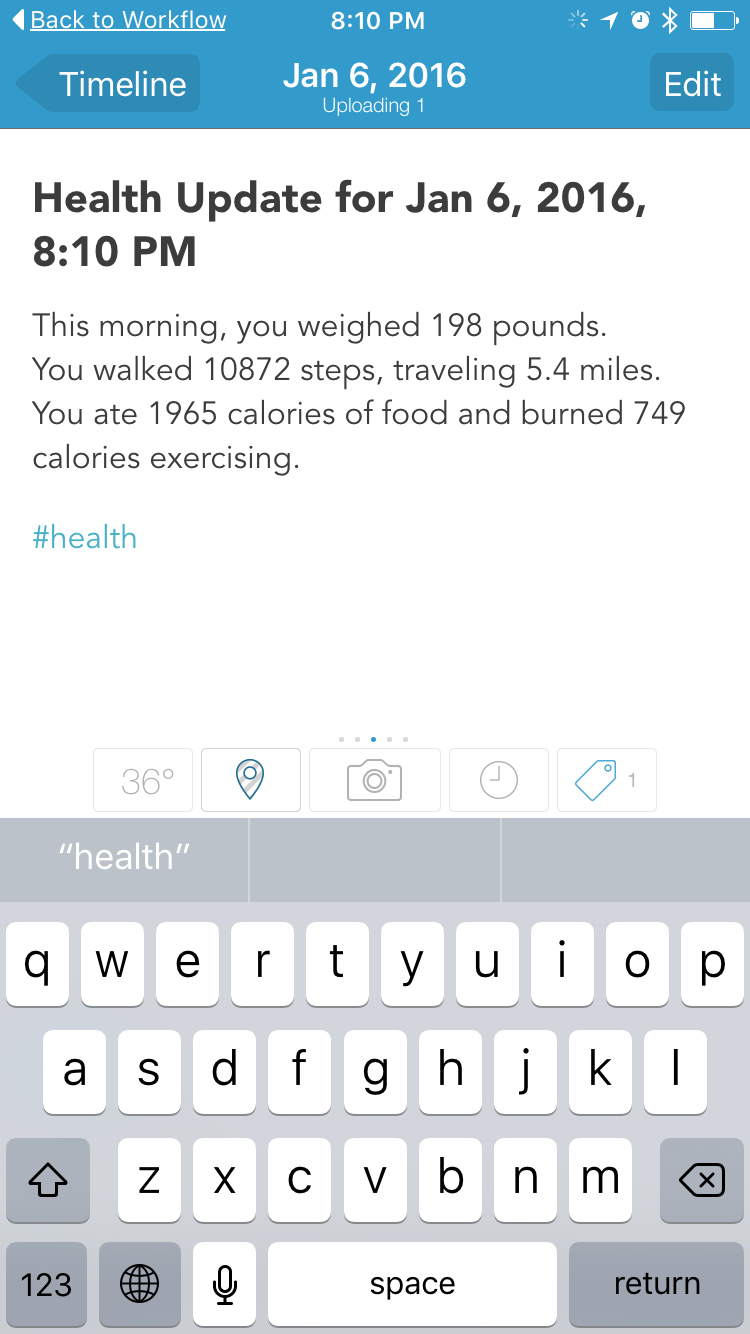
Workflow recently added support for HealthKit, both to save data to it, and pull data from it. What if I used Workflow to pull relevant data from Health, format it nicely, and stick it in a Day One entry with a hashtag to sort it out? It took some finagling, but I finally got something that works. Here’s what it looks like when it’s done:
Okay, not fancy. No charts or graphs, but it’s a succinct picture of my day, with all the metrics I’m tracking as I try and drop about thirty pounds or so. I could get way more detailed, and track macronutrients, but I don’t care about that. I’m just making sure I burn more than I consume, and making sure the big number trends downward.
If you want to use this yourself, or tweak it for your needs, you can find the workflow here. I have the Workflow saved as an action in Launch Center Pro, with a push notification scheduled for 9:30 PM each day, which is also when I get reminded to do my daily journaling.
Hopefully, future versions of Workflow add support for getting the amount of time spent working out, and maybe access to sleep data, so I can get a bigger picture. Either way, what I have is a good, simple start for taking control of my data and seeing what I’ve been doing. Or, I suppose, not doing, if I ever fall off the wagon.
If you haven’t read or watched “The Website Obesity Crisis†by Maciej Cegłowski, you really should. It’s one of the smartest things said or written about the state of the Web today. It’ll also help you get some context for the essay to follow. So, go click that link. I’ll be here when you’re done.
Okay, are you back? Great. Now, let me cite one of Maciej’s concluding parts.
Let’s preserve the web as the hypertext medium it is, the only thing of its kind in the world, and not turn it into another medium for consumption, like we have so many examples of already.
There’s a lot to unpack here. I know where Maciej is coming from. I work in digital publishing, I’ve been making stuff on the web for nearly twenty years, and I am trying to teach myself modern front-end development. The Web in 2016 is very different than the Web of 1996, which when I first got online. I learned the basics of building websites that same year, out of a copy of HTML for Dummies: Quick Reference. You could, at the time, make something throughly awesome by going to “View Source†on any website on the Internet copying, pasting, and fiddling with the code.
Now? Well, have you ever tried viewing the source on Google.com? I did once, and I when I came to, I was naked and covered in what I hoped was my own blood. Web development is hard, things are bloated, and the sense of independence and fun of making stuff on the web is largely gone. It’s been replaced by blue and white faux-minimalism that grinds your computer to a halt to load ads. It’s no fun.
Making anything cool now, well, it takes a lot more work and knowledge than it did in 1996. Even if you’re just building the theme for a blog, you need to know a lot more to make things look awesome everywhere. And awesome looking stuff takes a lot more computing power to render. So…
Let’s commit to the idea that as computers get faster, and as networks get faster, the web should also get faster.
Here’s the screwy bit. Aside from a period when mobile devices that could view the real Web were just taking off—basically with the original iPhone—computers, networks, and the web are all getting faster. It’s just that once things get fast enough that we get even the slightest bit of overhead, web stuff gets more complex and demanding on the network and the computer. Just look at the development of JavaScript interpreters in browsers. There’s an arms race to optimize how fast a browser handles JavaScript, and it has had a performance impact for the better.
It’s not even a new problem. The move to semantic markup and CSS was actually supposed to speed the Web up for users. You might have to download another page, but your browser kept the CSS file and images cached. Pages loaded faster, and rendered faster, at least as your computer got faster. Then, with all that freed up computing power, web people decided to try crazier stuff. And things got more complicated and slower to load. Either the technology catches up (broadband), or we start stripping stuff down again (early Web 2.0). It’s cyclical.
There was a period in the 90s when computers completely revolutionized print typography and design. People were making, and publishing really wild stuff, but it was a fad. There was eventual pushback over crazy neon colors, hard-to-read fonts, and screwy layouts that looked insanely cool, but made reading print a huge pain in the butt. If looking at those examples reminds you of the late 90s on the web, you’re not far off. That aesthetic carried over to many websites, too. I dare you to look at wired.com circa 2000 on the Internet Archive.
Fortunately, that cycle is moving towards simplification again. The pushback on bloated ads, tracking scripts, and all the excessive crap that spins up our laptop fans and pushes us over the data limits on our mobile plans is reaching a head. Soon, we’re going to have a reckoning. How it shakes out is yet to be seen, of course. The result could be even more siloing of content behind the walls of tech companies who want eyeballs and data to monetize on. I’d like to see something more akin to what Maciej wants. The web needs to “stay participatory.â€
But, even when the web was largely hypertext, it was’t all that participatory. Twenty years ago, the Internet was just starting to penetrate into ordinary people’s homes. The tipping point there was probably settling on the 56K Modem standard, and AOL opening up its walled garden to the Web at large. We were all going to connect in cyberspace over ISDN lines and something, something world peace. Really, most early adopters were more interested in drop shipping carpet, finding porn, or both.
At A Working Library, Mandy Brown is on to something in her great piece on Maciej’s talk.
“There’s an old saw about the web that says that when the web democratized publishing, everyone should have become a writer, but instead most of us became consumers. (Nevermind that email and SMS have most people writing more in a day than their Victorian ancestors wrote in their entire lives.)â€
Mandy’s seeing Maciej’s argument from the filter of a writer, and I’m seeing it from the filter of a writer and a web… site… making… guy. I don’t think the creator of a really awesome web bookmarking app is advocating we give up making cool applications that use the web as a platform. More that we people who make stuff on the web strip this crap down and focus on making awesome stuff everyone can use without compromising a user’s computing power or their privacy, and make it easier for someone to get started making that awesome stuff.
Which is going to be very, very hard for a lot of reasons, but laying those out will have to wait.
This is it. 2016 will finally be the Year of the Internet of Things, which is fast replacing the Year of Linux on the Desktop as a perennial fantasy tech prediction. Guaranteed, as CES comes to a head, every consumer technology company will show of some sort of connected home device. There will be a 500 word gadget blog piece on each. And they’ll either never reach the market, or summarily tank when they do. The optimism shall continue unabated, if only because there’s a still an untapped market of consumers with dumb, functional home devices that they’ll have to replace at some point, anyway.
Over at The Kernel, AJ Dellinger is cutting through some of the IoT nonsense, and he has some help from Nest CEO Tony Fadell of all people. The entire piece is well worth your time, but this is the big takeaway for the home:
When we think IoT, we think of things shown through the “smart house†trope, and companies already in the appliances business happily oblige the fantasy…
Sure, we have a ton of Internet-connected things, mostly RFID stuff for industrial applications. Home users are left with a frustrating, broken, insecure, and fragmented ecosystem of competing standards and platforms. There may be something to connected home stuff, though I remain skeptical. I’m unwilling to invest in expensive hardware to smarten up an apartment I might not be staying in for the long haul. Either way, the privacy and security aspects freak me right out. Let me cite Dillinger again:
These are billion-dollar industries that would love to be able to better target potential customers, and the data is floating around inside everyone’s homes. Google and Samsung, among others, are trying to capture it—and as interested as they are in selling it, they aren’t all that into the idea of sharing it.
And what the hell am I theoretically giving all that data up for? Aside from smart thermostats, nobody’s shown that potential in the home beyond a bunch of neat tricks with lightbulbs, and maybe having your phone go off when your food is finished cooking. (How is that easier than saying “Hey, Siri, set a timer for 30 minutes” to my Apple Watch, again?) It’s the data and insight into process that Internet connected sensors bring into our lives is valuable. That’s why advertisers want dibs on it. Dellinger seems to agree:
Businesses will continue to adopt the Internet of Things, and consumers will be able to benefit, whether by package-delivery notifications straight to their phones or sharing information from their Fitbits with their doctors. The $70 lightbulbs that connect to the Internet, though? They’re not going to be flying off the shelves.
Maybe I’m just missing something. I’ve been cynical about new product categories before. If anyone knows of a product that isn’t vaporware that has a quantifiable benefit over a non-computerized dumb appliance, I’d like to see it. Until someone comes up with the killer app for all of these expensive “smart” things they want to shove into my home, I’m going to remain skeptical.
“Ideally, you should be using the smallest possible gadget to do as much as possible before going to the next largest gizmo in line.â€
This is eminently reasonable, and I’m kicking myself for missing it the first time. It’s a philosophy I’ve chosen to (try and) take to heart in the new year for my technological life. How does this play out in practice, though? Let’s start with the smallest device: the Apple Watch.
I would love to use my Apple Watch for more, but the combination of a fiddly interface and the slow speed makes me keep reaching for my phone. As I wrote in my six month update of life with the Watch: “If there’s been a theme… it’s figuring out what I want to get out of [the Watch], and dropping what it’s bad at.â€
I’m still trying to settle on a set of core functions that I can do on my Watch easier and faster than on my phone. So far, that’s fitness, (some) contextual computing, and notification triage. [1] What it’s not is communication—too many friends not in the iOS messaging ecosystem. What I might have to do to get more out of my Apple Watch is insist on keeping my iPhone out of arm’s reach unless I really need it.
As for the iPhone—it’s my primary communication device, and my portable entertainment device. A huge chunk of my music library lives on there, along with audiobooks and podcasts. The way I use my iPhone hasn’t changed a great deal since iOS 7. The extension frameworks and improvements to multitasking and sharing have made life easier, but the fundamentals remain solid, which is fine by me. I haven’t gotten much use out of the “proactive†features in iOS 9, but they look like a solid foundation for more context-based computing.
My iPad is one of those devices where I’ve struggled to fit it in with how I use technology. Growing up as a traditional PC user—craving a mouse, a keyboard, a giant display—combined with the difficulty of doing (ugh) “real work†on an iPad creates a recipe for inertia. My iPad 3—that’s the first one with Retina, for those keeping track—was long in the tooth, and an upgrade was long overdue. I got myself an iPad Air 2 for Christmas. I know there’s an iPad Air 3 in the works that’ll likely have support for Apple Pencil, but meh. In a few days with the Air 2, however, I’m already making a conscious decision to use it over my Mac for a lot of things.
The new iPad is finding its niche for me as a lightweight, fast, easy way to do reading and writing. Split view and slide over apps are so good. My previous iPad felt so limited that there was almost nothing I could do with it beyond the occasional bit of writing, reading RSS feeds and comics, and plinking around in GarageBand. I don’t know exactly what else I’ll want to do with this thing yet, but I’m willing to give anything a shot. I’m also excited to see what iOS 10 has in store for the iPad with the sheer computing power of both the Air 2 and the Pro.
Finally, there’s my Mac. The Mac is where I get all my heavy lifting done, but also where I do most of my slacking off. Games, social media, writing code, writing text, you name it, I’ve been doing it on my Mac. When I work from home for my day job, I do it on my Mac. If I’m going to be doing more on the smaller devices, the Mac has to, of course, be the device I step back from. Now, it looks like I have a setup and an ecosystem that makes overcoming the inertia of being a traditional computer user worth it. We’ll see what happens as the year progresses.
December is the hardest time to be on the technology beat. It’s the slowest month of the year, which is why most technology journalism bends towards the best deals on potential holiday gifts, best-of lists, or best-of lists of potential holiday gifts. If you’re wondering why so many people are writing hot take thinkpieces on Apple’s new battery case, now you know. There is nothing else to talk about.
My own writing has often tapered off near the end of the year—often there’s just nothing to write about. Combine that with the general madness of the holiday season, and it’s a recipe for doing anything but making the clackity noise. This year has been especially maddening, when you factor in recent events in the Apple blogging community. I don’t even consider myself an Apple blogger, though I certainly have a toe in that pool. For my own role in the Bielefeld saga, I apologize. I’ll probably be on Marco Arment’s Twitter blocklist for eternity, which is my punishment for being suckered, I suppose.
But it also leaves me thinking about the nature of technology writing, my writing, and a feeling of dissatisfaction with the general beat. There’s the endless cyclical arguments about App Store pricing models, about whether an iPad can replace a Mac, about thinness versus battery life, about the Android approach versus Apple. The more we go around and around in the circular arguments, the less I care. I’m a user of consumer technology: personal computers, tablets, smartphones, smartwatches—but I’m not captivated by the devices themselves. They are tools, nothing more.
And I certainly don’t care about the stock prices and earnings reports about these companies. As long as the companies that make the tools I use stay in business, that’s all I need.
I care about what we can do with these tools. I care about what these tools are doing to us. I care about the people—not just coders, hackers, and designers, artists, citizens, and the global community. It’s a sentiment I’ve stated here before, after the wonderful Facets Conference, back in May
I’m sick, tired, and just plain bored of breathless excitement over the latest and greatest consumer gadget. I’m also sick, tired, and just plain bored of breathless anger over the latest and greatest consumer gadget. It gets us nowhere, and I’m as guilty of this as anyone else… I’m not saying there’s anything wrong with occasionally looking at the tech world from that level, but right now I feel like it’s missing the forest for the fourth leaf on the middle-bottom right branch of the thirty-seventh tree to the east-southeast.
But there’s a problem. When I try to think about these things, when I step out of the comfort zone of writing about consumer technology and try to write about bigger topics, I get lost. I’m not a programmer, I’m not a hacker, I’m not a technology academic. I’m a gadget nerd who failed a Computer Science program and went back to school for a Liberal Arts degree. [1] I want to learn more, I need to learn more, and I don’t know where to start. And, why lie, the numbers on the posts where I do write about these things aren’t nearly as good as the ones about Apple and gadgets.
This isn’t to put down the work of the people who write about gadgets, about Apple’s finances, about battery cases, and keep up with the day-to-day minutia of happenings in tech. They do work that is valuable to someone—often work that is valuable to myself, too. Keeping up with what’s happening in this space, even if it’s just new products, is important. I just don’t feel the need to read fifty stories rehashing the same press release, and listen to six podcasts rehashing the fifty stories—but you do you, you crazy gadget lovers and Apple followers.
Moving into 2016, I hope to move further away from writing about gadgets and Apple stuff, and more into writing about the bigger issues and topics that technology touches. I also plan to write more about music, since that’s a passion of mine. (Keep your eyes out for my best music of 2015 post, coming before year’s end.) If nobody is going to write the blog I want to read, it comes down to me. It’s going to be a struggle and a journey of discovery. I’m hoping there’s a few other seekers along the path who will join me. There’s more to talk about that’s happening beyond the latest smartphone accessories. Let’s find it.
I am working on a programming project that I will talk about another time. But, being able to write code is not the same thing as being able to think and write about technology on the level I aspire to. ↩