Ian Bogost recently published a commentary on “Hyperemployment” in The Atlantic. It starts with the de rigeur comments on how we get too much email, then moves on to the obligations we’ve opted into through social media—especially Facebook. It would seem like the typical curmudgeonly ramblings of anti-Internet/social media types, until this part:
Often, we cast these new obligations either as compulsions (the addictive, possibly dangerous draw of online life) or as necessities (the importance of digital contact and an “online brand†in the information economy). But what if we’re mistaken, and both tendencies are really just symptoms of hyperemployment?
I don’t consider posting on Facebook and Twitter to be exploitation, but the necessity of building a personal online brand is something worth discussing. As someone who is in the middle of job hunting, it certainly hits home. Job hunting in the age of social media is job hunting in the age of utmost scrutiny. It’s not uncommon for prospective employers to scour a candidate’s social media profiles. I did it myself when evaluating summer interns at my previous job. On Episode 41 of QUIT!, Haddie Cooke mentions a college professor who made one of their final class days “Facebook cleanup day,” and recounts a frightening story of what happened to a student who decided to skip it.
This goes way beyond not having pictures of yourself smoking weed on your Facebook. Even the already employed in some fields have to keep up a social presence, along with their actual work. Mimi Thi Nguyen is an academic in the digital humanities and writes that:
To remain relevant [in academia], we are told we must blog, tweet, and code (whether this means learning genetic and neurobiological chemical formulas or computing languages). But it is important to ask, To what end?
Your social media profiles, your passion projects, the internships—paid, and unpaid—you take to get skills, all of these things become your personal brand, and the personal brand subsumes all. Maintaining your personal brand is a full-time job in itself. Vulture posted an interesting piece by Joe Jonas of The Jonas Brothers on the difficulties of living in the spotlight under the Disney brand that offers an interesting perspective on personal branding. It’s not quite that insane for the majority of us. There’s a reason Disney has a team of people to handle the hard work of brushing indiscretions under the rug. It’s just that the rest of us have to keep up our own appearances.
As Ian Bogost writes:
Today, everyone’s a hustler. But now we’re not even just hustling for ourselves or our bosses, but for so many other, unseen bosses. For accounts payable and for marketing; for the Girl Scouts and the Youth Choir; for Facebook and for Google; for our friends via their Kickstarters and their Etsy shops…
My personal brand got me my last job. [1] Having Sanspoint and Crush On Radio showed that I had the skills needed for the role I would take on, and could teach myself new ones. A few months ago, I considered shuttering Sanspoint and starting a new project to focus on my technology and culture writing. As I thought about starting from scratch, building a new audience, a new brand, I realized, first, how integrated this little blog was with my online identity. I’d have to do a lot more than just buy a new domain and set up a new WordPress installation. I’d have to build my personal brand all over again, and that is hard. It’s even harder when you’re already employed.
But is all of this hyperemployment and brand building exploitive? One reason why I was poking and prodding at the Facebook profiles of prospective interns is that they would be publicly representing the company on social media. If they know how to manage their own profiles well, it shows they would know how to manage a business’s profile just as well. It’s a skill, one they don’t teach in school (yet), and not every job requires it. There are still plenty of jobs where what you do outside of office hours simply do not, and should not matter, as long as it doesn’t affect your on the job performance. Why should they have to worry about their online persona and brand?
And what about those who opt-out? We may see people abandoning “traditional” social media in the future. If Snapchat and other temporary sharing services have staying power, how will its users build their brands? Even today, there’s still plenty of people in the first world who don’t use any of this stuff, or use it only sporadically. In 2011, 40% of active Twitter users didn’t tweet, according to an interview with Dick Costolo. Can a personal brand be an absence thereof?
My personal brand also lost my last job. Saying that might keep me from another job, but I think an important part of who I am, online and offline, is based on honesty and a sense of ethics. ↩
Pono is 24-bit, 192,000-sample-per-second digital audio, as often used in recording studios. The only really new thing about it is that there’ll be a portable Pono player, which can play back that high-data-rate audio as well as more common formats…
The big deal about Pono is, of course, that 24/192 audio is meant to sound better even than CD, let alone lossily-compressed MP3s or AACs. According to Neil Young, digital-music listeners today, who are almost all listening to music data-reduced via MP3 or some other lossy codec, are as a result enduring sound worse than that from a 78-RPM shellac record…
Problem one, which is a bit of a biggie, is that 24/192 doesn’t actually sound better than CD audio…
Daniel Rutter makes some great points about the Pono format, but the most damning one happens after the last pull-quote. Time after time, tests have shown that beyond a certain level, even if you have perfect hearing, you’re not going to make things sound better. My hearing is damaged from years of loud earphones and louder concerts without earplugs, and for the life of me, I can’t tell the difference between a well-encoded v0 MP3, an iTunes M4A file, or a FLAC. I probably couldn’t tell the difference between any of those and Pono, either.
Pono strikes me as just the latest form of audio woo. I wouldn’t be surprised if it’s priced accordingly, too. You have to cover the cost of digitally recording and remastering all those master tapes at high resolution, after all. Speaking as a Neil Young fan, I hope he’s not being taken for a ride because he has money in the bank.
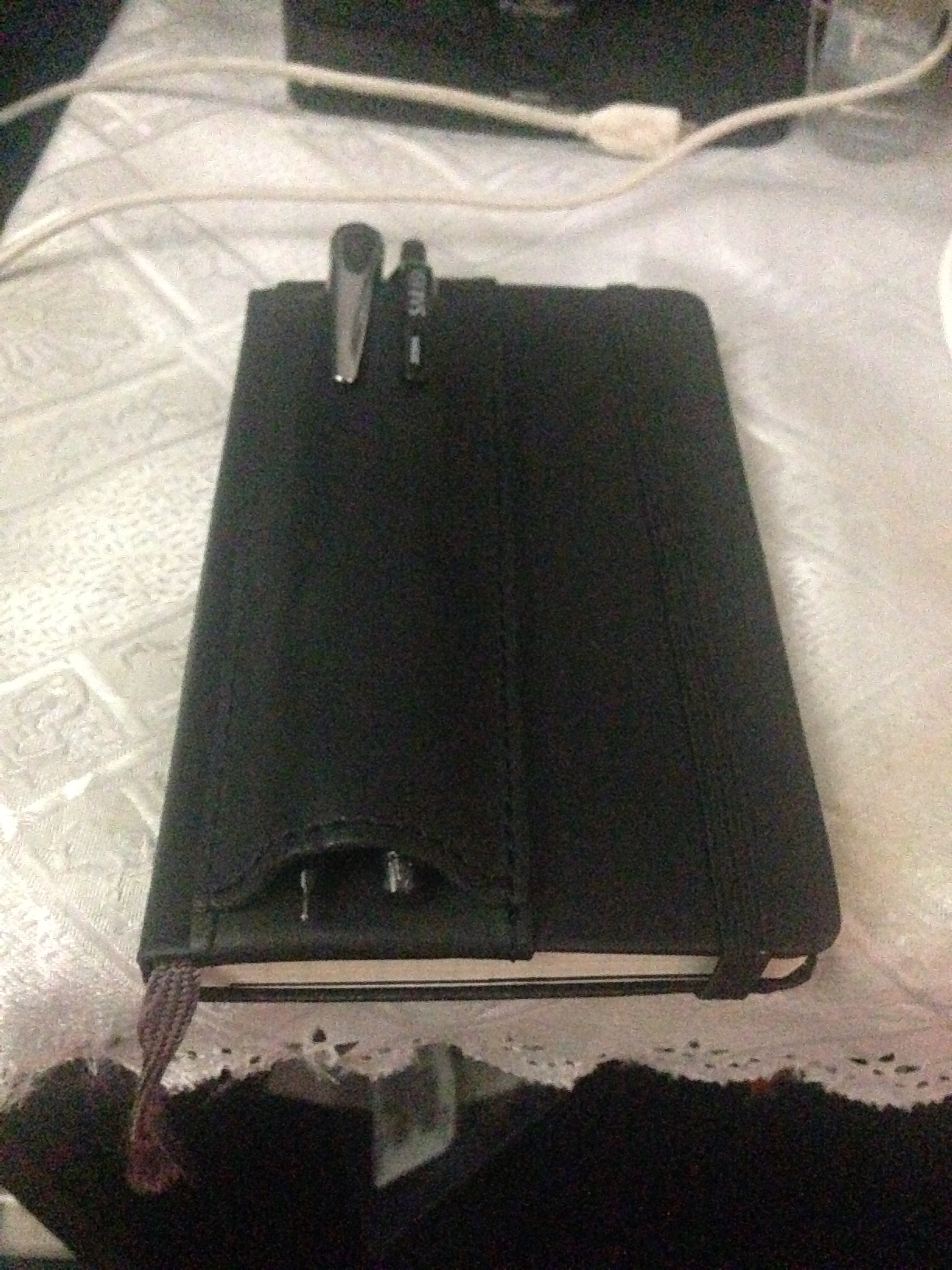
I typically carry a pen, everywhere I go. Oddly, the day I bought my to-be Bullet Journal notebook, I left the apartment without it, thus forcing me to wait until I got home to tear into the setup process. I also made sure to listen to Ryder Carrol’s interview on the GTD Virtual Study Group podcast. [1]
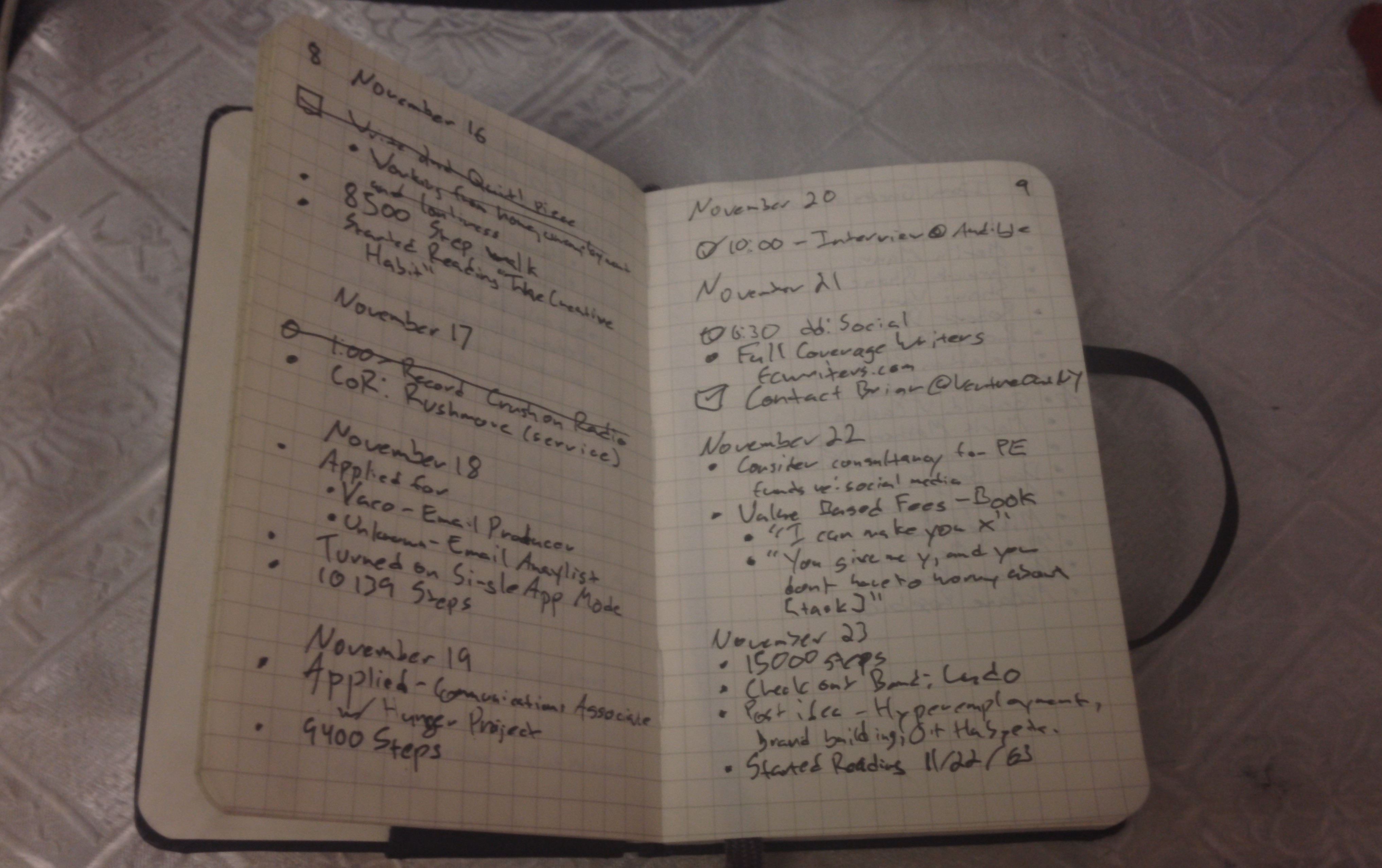
Bullet Journal is not made for pocket notebooks, though it’s certainly doable. My monthly calendar for november spans across two pages, and my monthly task list takes up the bottom half of the second page. This isn’t the most aesthetically pleasing option, but I’ll trade aesthetics fro portability. Besides, my atrocious handwriting is going to ruin any elegance the system has.
I also noticed that the Monthly Calendar pages do not handle multiple events well. On the 15th, I had three appointments to keep in mind, but I only had room for one on the page. As Bullet Journal encourages succinctness—a quality I lack, as you’ll know from reading other things on this site—I’ll blame myself for this one.
Usability
Great. Just great. I had the opportunity on day one to really give my Bullet Journal a workout when I attended a lecture at Columbia University on news, computational linguistics, and social media. [2] I scribbled away a page and a half of bulleted notes that are succinct enough to recreate the interesting parts of the lecture. That the notes take up a spread in the middle of my November daily calendar pages doesn’t bother me, as I have both the index and my Moleskine’s built in bookmark to keep my place.
I did purchase an accessory to make sure I wasn’t without a pen anywhere I carried my notebook: a double pen pocket notebook Quiver. It took its time getting to me, but I can’t imagine carrying my notebook around without it. I keep a Zebra Sarassa pen in there, along side a Pentel mechanical pencil, just in case there’s something tentative to put down.
One thing I noticed is that people really like to see you write stuff down in a notebook. When I type things people tell me into my phone, there’s no excitement. On several occasions, writing stuff in my notebook caused people to react very positively. I especially noticed this effect at a technology event I attended, sponsored in part by Google. Let’s see Google Glass be this efficient and reliable, huh?
Where It Fits In
Nothing incriminating, I think.
What have I been writing in my Bullet Journal? Whatever seems relevant. Daily steps, notes on calls and meetings, what jobs I’ve applied for, post ideas for Sanspoint and elsewhere—anything that I’ll want or need to know later. Bullet Journal’s found a niche for me as a structured way to capture little bits of data I collect throughout the day, when I know I’ll need or want to refer to them again. Not every day gives me data to collect, but it’s good to have a structure.
Bullet Journal is not, however, a task management system for me. If one of those pieces of data I happen to collect is a task, then I collect it and mark it as such with a square box for a bullet. However, I still keep all my to-dos in OmniFocus, where I can manipulate them, organize them, and build them out into projects or subtasks, as necessary for my poor, addled mind. I admire people who can see a task like “Redesign website†and handle it from there. I need more detail, and while Bullet Journal can do that, I would prefer to keep it as a capture system.
What To Improve
My handwriting. And remembering to actually write stuff down when I think of it.
Final Thoughts
I don’t know if anyone necessarily needs a full on system to use something as simple as a notebook. It’s pretty intuitive. As Merlin Mann said, “Nothing doesn’t go in here.â€[3] What I like about having a system is that it’s a good MacGuffin for getting me to crack open the damn thing every now and then and scribble something down. More importantly, half of the value of a notebook is the ability to go back and see a snapshot of your life. It’s something I’ve missed out on. Hopefully, using Bullet Journal will give me notebooks full of good stuff to look back on in time.
A note, before I begin: I have only a year of experience in the world of startups, and I am unsure if my experience is typical. Some probing of others suggest that it is, if not typical, at least not unique. My experience shades some of my thoughts. However, the particular startup I worked for allowed me to see some parts of how the sausage is made, in terms of venture capital and funding. A lot of what I saw, I did not like, but this may be from my particular experience.
I wonder if we have our priorities a little screwed up. When I think of the word “entrepreneur,” I think of someone who is trying to build something and shepherd it through the long term. It’s bringing something into the world you want, scratching your own itch, but other people’s itches as well. If you’re not scratching their itch, you’re not going to last long as an entrepreneur, after all. You don’t enter into it lightly. If you bring on employees, you accept responsibility for them, and they for you. When this happens, you’re not just building something for yourself and your customers, you’re building something for your employees and their families too.
However, when I look at the startup world, I don’t see a lot of that. I see a lot of people who just want to make lots of money, and a few people who want to scratch an itch. And as more people make lots of money in this game, even more people with lust for money are getting into the game with silly, frivolous ideas that tap into exactly what will get them large amounts of funding from people who also want to make lots of money. That second group are venture capitalists.
There’s nothing inherently wrong with venture capital, and there’s nothing inherently wrong with building something frivolous. So many wonderful things have been created in the spirit of frivolity, and many of the tools I use every single day have been born because someone else invested money early on. When applied right, venture capital is a great resource to help someone with a great idea get it off the ground and moving under its own power. When applied wrong, it gives us speculation, a bubble of inflated company valuations like $4 billion for Snapchat before they’ve made a single dollar—even if they have a monetization strategy now.
One part of this comes from the sheer shadiness of—again, some—venture capitalists. Another part comes from the inflated value of “entrepreneurs”. Most ventures are going to fail for some reason or another. I wonder how many venture-backed companies like Everpix fail because the VCs were too hot and bothered by “the next Facebook,” or some college drop-out in a nice suit with a dumb idea that will get a lot of users, even if it can’t make sustainable money. The more “entrepreneurs” who make it big and get the huge payout, the more people will desperately follow in their footsteps, waving their business plan and/or prototype app at the VCs in the hopes of free money.
But that money isn’t free, and I don’t mean in the sense of giving up equity in exchange. The money used to fund startup companies comes from somewhere, and it’s typically not some lucky winner’s largesse. Venture capital funds raise money from government and private pension funds, college endowments, non-profit foundations, and institutions that manage the sovereign wealth of entire nations. They invest because they hope to make enough back to pay retired workers, pay professors, build schools and infrastructure, and more. Considering the risks involved in venture capital, should there not be greater stewardship of that money? Is a smaller, steadier return not better for the people whose money is truly at stake, rather than finding “the next Facebook”? And this doesn’t even factor in the venture funding for things like clean energy solutions, new medical treatments, and other things that will only pay off in the long term, if at all. It’s too risky for investors whose only thought is how to get the company to a profitable exit, and fast.
This may be why I don’t invest in anything. That, and the lack of money to do so.
There are VCs out there who do want to help a company succeed, and will work with the companies they’ve invested in to put them on a solid footing. They share their experience with similar companies they’ve worked for, founded, or invested in, identifying the pitfalls and showing a clear path—if the founder will listen. There are also VCs out there who don’t care what the company does, how, or why, as long as they get back their investment and make a tidy profit on top. One of these is more valuable than the other, but I see the influence of the latter type more often when I look at technology and startup news. That’s something I try not to do as often these days, but sometimes it’s inescapable.
I’ve been planning a new writing project to accompany Sanspoint. Where Sanspoint’s focus is on technology and culture, which are two things I think about a lot, I’ve also been thinking more about my own life and the work I want to do.
Above the Runway is about that. The focus will be on figuring out ways to improve my life and my work, both with technology and without. It will be about gaining perspective, and see how all the things I do fit together as I get past the runway, past 10,000 feet, and into the higher horizons of focus.
Above the Runway isn’t live yet. I’m still working on the content and supplemental things around it. In the mean time, you can sign up for my email list to find out when Above the Runway takes off. (I’m sorry, but you can’t have a site name like that without a little bit of airplane-related punnery.)
 , with the intent of giving