Time is the enemy. There’s so much to do, precious little to do it in. Factor in time needed for little things like eating, sleeping, and the little maintenance tasks we must do to keep alive, and it’s a small wonder anything gets done. So, we rush. Run to catch the train. Grab breakfast on the way. Get your work done as fast as you can. Take a short lunch. Eat at your desk. Work some more. Run to catch the train. Heat something up for dinner. Rush rush rush. It’s the only way you’ll have time for yourself.
Must it be this way? Especially with creative work, the axiom still applies: “Fast, cheap, good. Pick two.”
If you want something done fast, and you want it to be good, it won’t be cheap. In your working life, the cost is your own energy, and you only have so much of that to go around. The result is that, after you burn off the easy energy, your work begins to decrease in quality—as does your life. Mistakes slip in. Little ones. Big ones. The less energy you have, the more the pressure is on to rush, the more likely you’ll fuck up. If you’re lucky, you, or someone else, will catch the mistake, maybe even fix it. If you’re unlucky, lives are in the balance.
Most of us are lucky.
And the cycle continues. Rush. Sleep less. Rush. Work harder. Do Bob’s work. Do Velma’s work. Do your work. Work overtime. Work from home. Work Saturday. Work Sunday. Run yourself ragged, make more mistakes. As this continues, the mistakes get bigger, as do the blind spots. It’s done. Next thing. Go. Run. And in the back of your mind, or even in the front of your mind, a part of you is screaming for a solution. You work harder, trying to get ahead for a bit, so you can take a day off. Maybe a week. Vacation. That’ll help, right?
It feels that way for a while. Then you come back, and everything is piled up. You have to catch up. Do the work you missed, and the work that is coming in, and the work that your co-workers aren’t doing, because they’re on vacation now. The deadline is looming. Can’t push it back any further. Ship or die. Run.
And you ship. And then you find out about all the little things that you, and everyone else missed. You were too busy, too close to the metal, and moving too fast to see the mistakes that piled up. And that pile needs to be fixed.
And the cycle starts again.
This happens to all of us. It happens at the top of the org-chart, and it happens way down at the bottom. Especially at the bottom.
All you can do is try and slow down. Stop running, and learn to walk when things get tough. Walk, and take your time. Think through what you do, especially when it’s something you’ve done before. It’s easy to be like water and flow through the same deep channels of your habits. With each trip though, the channel gets deeper, and it gets harder to escape. When you rush, when you run, when you go on autopilot, the mind slips right into those well-worn channels and nothing new happens.
Only when you slow down, look around, and walk instead of run do you find ways to improve things, and to avoid the inevitable pitfalls you run into, day in and day out.
Stop running, stop rushing. Walk. Just for a little while.
I’ve spent the last few days living in fear. I’ve been afraid of the consequences of a mistake I made, and a very dumb mistake too. It has the potential to ruin my professional life, and more. What sets this mistake apart from the countless others in my life is that it could effect a lot of people, and their careers as well. Forgive the vagueness, but the nature of the mistake, its potential impact, and the audience of this site make me wary to go into details.
Fortunately, it seems that the worst has passed. I’ll find out for sure in a week or so. Talking with people aware of the issue has also helped me gain some perspective—it may not be as bad as I have made it out to be in my head. Still, worry is what I do best, and it didn’t help that this whole thing coincided with a bout of illness, which never helps anything. It’s affected my sleep, my appetite, and my ability to write. [^1]
There’s talk about failing upwards, the idea that the people who make mistakes go on to better things because they’re known. I’ve written about owning your own failures. Neither of these were any consolation in the late, worrisome hours, or during the hours of busy work fixing my mistake before the Sword of Damocles could fall. I’ll be satisfied when I know for sure the end result, but I’ve done all I can, and as far as I can see, it looks to be safe. What I’m not sure about is how far I’m able to see.
My mother has shelves upon shelves of books, to the point where it borders upon bibliomania. I suggested to her, once, getting a Kindle or using her iPad for reading, especially since she could adjust the text to better suit her vision. This was quickly rebuffed: she likes books.
On App.Net, I was in a brief conversation on mix tapes versus mix CDs and playlists. I took the case that a well made mix CD or playlist could be just as good as a mix tape. Aaron Mahnke’s response to the conversation, as well as Harry C. Marks’s both put the value on the medium over the content—the effort needed to make a tape is certainly greater than the effort needed to make a CD, or a mere iTunes playlist. I maintain, however, that though it is easier, the same amount of effort and thought can go into their digital equivalents. The ease is simply an excuse people have to be lazy.
A part of me sees this love for pure physical media, particularly older forms of it like cassette tapes, as ludditeism. Another part of me thinks about my book and record collections [1] that are sitting in a storage shed in Philadelphia. While I’ve rarely bought a new hard copy of a book since getting a Kindle, I still appreciate books for what they are. Certainly, I don’t have to worry about keeping my places in sync if I open the book on the subway versus at home. [2] On the other hand, if I had physical copies of everything I had in my iTunes library, I wouldn’t have anywhere to put them.
A vinyl record, a cassette tape, a CD, a hardback book, an ePub file, or an MP3—all of these are containers in one form or another. They come in many sizes, shapes, and colors. Some are more durable than others. [3] A container can be plenty valuable, and there’s nothing wrong with valuing it. One reason I collect records is because I enjoy the packaging: big album art, decorated inner sleeves, the way a record cover wears around the disc within… I also enjoy the experience of playing a record, and the physicality of it.
However, I listen to most things digitally. It’s easier, it’s the same music, and my ears can’t tell the difference between a CD, a record, and a good quality download beyond the superficial. Reading a book on a Kindle screen, my iPhone screen, or my iPad screen makes no difference—it’s still the same story, the same words the author put down in the first place. Same content, different container. For me, in my life, there’s more value when content is in smaller, more flexible containers like digital files, then there is in bulky, potentially fragile ones like CDs, records, and cassette tapes.
If you value the container over the content, I don’t know what to say. Perhaps it’s nostalgia. In the example of the mix tape, Harry Marks says that “The girl could feel your love in that fuzzy version of ‘Faithfully’ you recorded at 2am on a Friday morning before school.” That fuzzy version is the content—molded slightly by the container—but content all the same. It’s easy to get mixed up in nostalgia. As a music fan, I’m guilty of this too. However, the container is not the content, though it is very easy to conflate them.
To me, this disparity of evident motives is the most parsimonious way of evaluating the respective merits of opposing sides in any debate. If one side has no evident self-interested agenda beyond truth or fairness or the public good, that’s the side you should probably be listening to. Climate-change alarmists seem motivated either by evidence (in the case of the few people who actually know what they’re talking about—climatologists and geologists) or by faith in scientific consensus; climate change deniers seem motivated either by naked, mercenary self-interest (in the case of the oil industry and its flacks) or by a more general hostility toward inconvenient data (in the case of the Fox watchership). Gun advocates’ fervid idealism in defense of the Second Amendment reminds me of the uncharacteristically teary-eyed patriotic sentiment with which pornographers cite the First. Yeah clearly firearms are protected, in some sense, under the Constitution, as is freedom of expression. As a cartoonist and a writer, I’m kind of a First Amendment hard-liner. But in all honesty I have to wonder whether, if Alexander Hamilton or James Madison were to hear about the mass execution of schoolchildren in Massachusetts or happened to catch Busty Backdoor Nurses on hotel-room cable, they’d agree that this is just what they were envisioning.
I try not to talk politics on this site, mostly because I’m convinced that writing about politics on the Internet is a waste of your time and mine. This is exactly, however, why I want to link to Tim Kreider, who is not only a far, far better writer than I, but also writes about these topics in a fair-handed way that few ever do, while leaving ample room for debate and counterargument. Tim’s cartoons are often not as fair-handed, but that’s the nature of cartooning as a medium. See, for example, the artwork that opens up his piece.
All politics is a give-and-take discussion, and the entire thing falls apart when nobody, but nobody, is willing to step out of the ideological pit they’ve dug themselves into. This is no more apparent than in debates such as gun control, abortion, and any other argument where rights are to be given and or taken away. So much of this is viewed as a zero-sum game, and so precious little of it is. This is yet another reason why I don’t post political stuff on Sanspoint—I don’t want to get dragged into the debate, launching volleys from my ideological foxhole, and causing collateral damage to my readers who don’t want to get involved either.
No matter where you stand on guns, and I’m not telling you my stance, read Tim’s essay. It’s not just good political writing, it’s good writing. I feel the need to link to it from that alone. Its subject matter is almost secondary.
Have you heard about the Quantified Self movement? Basically, it’s a subculture of people who use gizmos and gadgets to keep track of what they do every day: what they eat, how they feel, how much they sleep, and how much they move around. The motivation for such obsessive data collection about yourself is a little nebulous to me, but I see the benefits when this tracking is done with a personal goal in mind. Tracking your food and your exercise is great if you’re trying to get fit and lose weight, which is something geeks like me tend to struggle with.
There’s a number of gizmos and gadgets that attempt to cash in on this trend. They come in all shapes and sizes… well, they come in little things you wear around your wrist, or little things you clip onto your belt. They’re also not cheap. A Fitbit, which is the most well known of these devices, will set you back $100 for baseline model. [1] That’s a little pricey, but for a densely packed bit of sensors and gyros, it doesn’t seem grossly out of line.
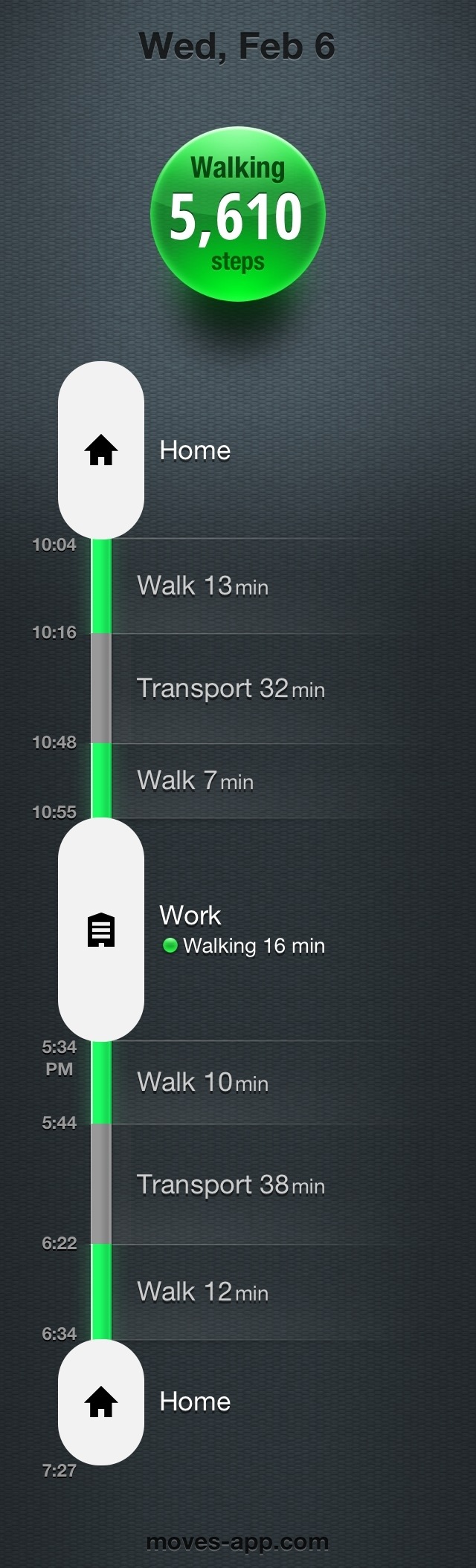
However, we already carry a device with all the gyroscopes, accelerometers, GPS receivers and other sensors needed to track our every movement: our smartphone. [2]Moves is a free app for the iPhone that promises to tell you exactly how much moving you’ve done each day. It’s capable of tracking how much you walk, run, and bike, as well as knowing when you’re traveling by car or train. It knows where you stop off, how long you’re there, and how much you’ve moved around while there. And it shows it all in a nice, attractive “Storyline†interface. [You can see mine here.](http://www.flickr.com/photos/sanspoint/8451508673/)
Moves is not the first application I’ve used to track my movements. For a while, I used MotionX Sleep, which also, yes, tracks your sleep. I ditched MotionX’s app because it crammed way too many features into an app. Navigating it was an absolute pain, and its sleep tracking paled in comparison to Sleep Cycle. Moves is a much simpler application, and therefore much easier to use. (Also, it’s icon is a lot nicer.)
It’s absolutely dead simple to use. Install the app, launch it, and go about your day. It runs in the background through some magical API that I presume to be undocumented, and uses the iPhone’s array of sensors to determine, roughly, where you are, how fast you’re traveling, and when you stop. If you’re anal about this sort of thing, and I am, you can even identify the places you’ve stopped off at. It comes with “Home,†“Work,†and “School†as basic, pre-populated options, and can pull a list of nearby places from Foursquare as well. You can view where you were during the day on a map, with green lines for walking, purple lines for running, blue for biking, gray for transit, and little bubbles for your various stops along the way.
Naturally, all this tracking means that your iPhone will be using sensors typically left off, and that means it’ll be using more battery. Moves promises that you’ll be able to get a whole day’s use out of your phone if you charge it fully at night. This seems to hold out, though the battery on my 4S dropped precipitously on a recent bus ride down to Philadelphia—so much so, that I turned the tracking off. However, I typically keep my phone plugged in at my desk, so I don’t have to worry about battery drainage anyway.
Moves does exactly what it advertises,[3] and it does so at a price point that makes no sense to me whatsoever. It’s not perfect. When it loses the GPS signal as I go into the subway each morning, it suddenly tracks me a good mile and a half northeast of my subway station before realizing I’m on the train. You can attempt to reclassify the paths on the map, but do so at your own peril. Trying it with my walk to the station today ended up with Moves thinking I either walked the whole subway trip, or rode the subway from my building door straight to the office door and now I can’t change it back.
Still, for the price, especially compared to a Fitbit or a Jawbone Up, Nike FuelBand, or all the other tracking gizmos out on the market, Moves is a perfectly valid alternative and an absolute steal. It could be even better if they added a little alert to say “Hey, you’ve been sitting at your desk for an hour. Go take a walk,†which is a feature I miss from MotionX Sleep. Integration with RunKeeper, Fitocracy, MyFitnessPal, or any of the other iPhone fitness tracking apps would be a nice bonus, too, but that’s not so much gilding the lily as it is dipping the lily in solid gold, and covering it with diamonds. If you want or need a way to track your own movements, own an iPhone, and don’t feel like buying another piece of hardware, Moves is exactly what you should get.
Fitbit sells a cheaper model for $60, but that one’s basically a glorified pedometer. ↩
If you think I was referring to the tracking device planted under your skin by the NSA, please remain where you are so that we can wipe your memory. Thank you. ↩
I didn’t test how well it identifies cycling, but that’s because I lack a bicycle. Someone stole mine. ↩